

The Deal
Code System
The Deal
Code System
We believe persistent profitability can be achieved across a wide range of market conditions by developing a portfolio of diversified, independent, limited risk, high conviction investments.
At the heart of Hudson Bay's portfolio construction is our development of "Deal Codes," designed to be a scalable, repeatable, and disciplined framework we use to organize and monitor investments.
A Deal Code represents a distinct investment idea and includes the core position(s) and appropriate related hedges, monitored and adjusted over time in an effort to extract alpha from the market. Our patented risk and portfolio analytics1 support and sustain our Deal Code-based approach. Our Deal Code System embodies three key criteria that are integral to our investment decision-making process and that we believe are critical to the goal of constructing an absolute return portfolio designed to generate consistent, risk-adjusted returns under most market conditions.
1US Patent Nos. 8,577,775; 9,940,673; 10,140,661; 11.657.455; 10.991.047; 12.182.869 and additional patents pending.
I
Investments should be beta neutral at the position level wherever practicable.
II
Positions generally should be sized to a limited loss threshold.
III
Positions should be high conviction.
Our collaborative environment promotes synergies across the investment teams. Navigating the inflection points between strategies creates opportunistic "combination investments" that seek to generate alpha for the firm.
We seek to generate alpha by focusing on the relationships that connect corporate bonds, convertible bonds, bank debt, credit derivatives, credit indices, and equities. The strategy involves both capital structure arbitrage opportunities as well as relative value opportunities across issuers.
We employ an event-driven, capital structure arbitrage approach to investing, looking to unlock value by capitalizing on opportunities when various parts of the capital structure are pricing-in different probabilities of an event taking place. The strategy applies modeling and indenture analysis seeking to profit from convertibles that may be misunderstood by the marketplace. The strategy takes a disciplined approach towards hedging, including utilizing predominantly issuer-specific credit hedges, which we believe enables the strategy to protect on the downside in the event of severe market or issuer distress.
We also invest in structured convertibles which entails, among other things, conducting in-depth fundamental analysis and structuring experience seeking to provide customized financing solutions predominantly to growth companies.
We look across the capital structure seeking to take advantage of dislocations created by corporate events, catalysts and change. We attempt to generate additional alpha by trading the pathway or turbulence around an event.
We perform fundamental analysis across a diversified set of industries and invest in equity and equity-linked securities. The discipline imposed by the Deal Code process and its emphasis on investment-level hedging and accountability differentiates our equities strategy. We also aim to combine our equity sector-specific Portfolio Managers with those in different disciplines to capture synergies across the firm.
We seek to profit from mispriced volatility within and across issuers and sectors. Our volatility Portfolio Managers also assist other parts of the Hudson Bay investment team in constructing option overlays with the goal of optimizing the risk/reward profile of our investments ahead of events such as earnings announcements and M&A outcomes.
Risk management is integrated throughout the portfolio construction and investment process and at all levels of our firm. We believe our Deal Code Portfolio Construction Process allows us to granularly manage and monitor potential downside risks in our portfolio.
We believe the key to consistent performance is to create and maintain a diversified portfolio of high-conviction, independent, and limited loss Deal Codes.
We evaluate our investment ideas at the position (or Deal Code) level. Neutralizing beta at the position level simplifies portfolio management and, in our opinion, enables the portfolio to benefit from the power of diversification. Risk guidelines set at the Deal Code level foster the construction of a portfolio of independent, diversified trades with limited downside.
We utilize RMon, a proprietary risk monitoring system, to facilitate daily monitoring of portfolio diversification through our patented statistical measure, the Gerber Statistic2 . We created this system in response to our concern that the common measures for diversification, such as correlation and covariance, have not kept pace with the increasing complexity and dynamism of financial markets.
2 US Patent No. 8,577,775
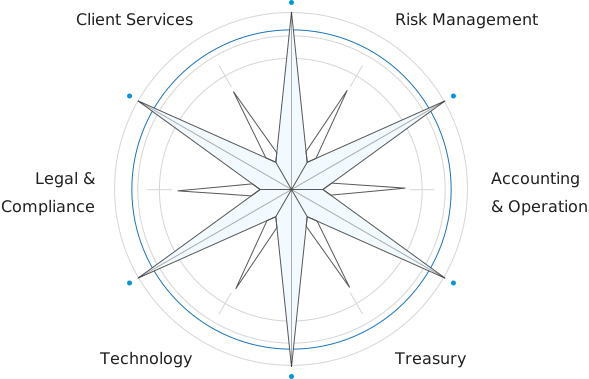
Tying it all together: The Deal Code System facilitates a disciplined institutional infrastructure, which, in turn, both supports and protects our firm.
This infrastructure – built by a strong team of business professionals – promotes insight and transparency across all departments. Communication among our business and investment teams enhances our ability to trade in a stable and secure environment.